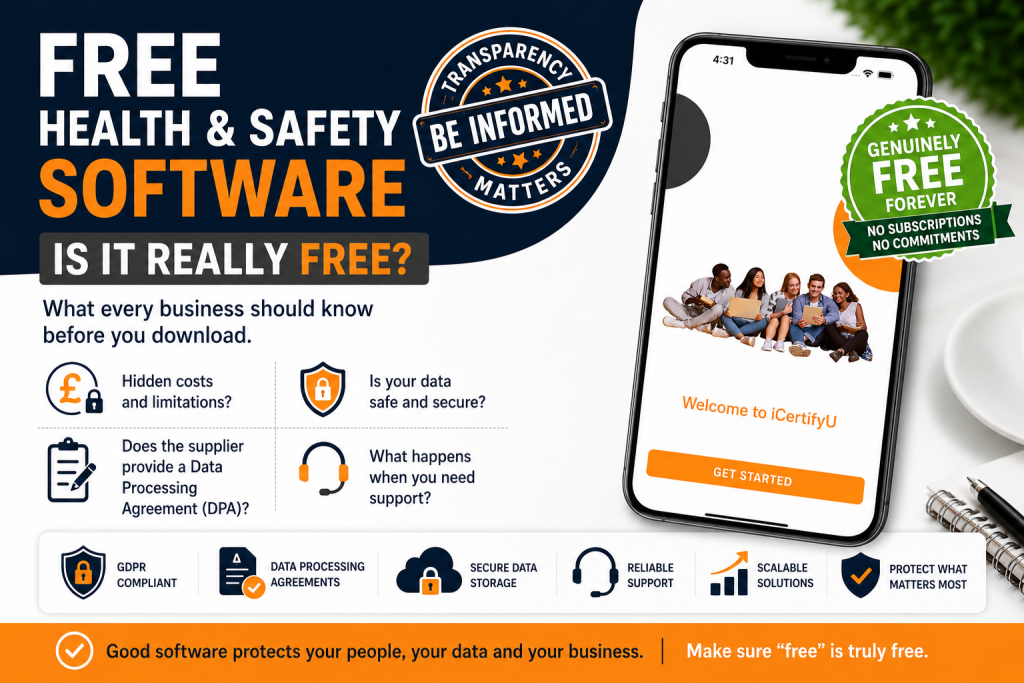
Free Health and Safety Software
Is It Really Free?
Search Google for “free health and safety software” and you’ll find hundreds of results.
- Free risk assessment software.
- Free incident reporting software.
- Free audit software.
- Free compliance software.
- Free health and safety management systems.
But there is often one problem: Many of them are not actually free.
Some are time-limited trials. Others are heavily restricted versions. Some require credit card details, forms, sales calls or upgrades before they become useful. In some cases, software advertised as “free” simply acts as a lead generation tool to increase website traffic and Google rankings.
For organisations genuinely searching for free solutions because budgets are limited, this can be frustrating.
Small businesses, charities, start-ups and community organisations often search for free software because they simply do not have the budget to purchase a full enterprise system. They are not future buyers waiting to be converted. They just need practical tools to help manage health and safety.
Some organisations such as government bodies, HSE UK, OSHA, HSA Ireland provide free and extremely useful resources, so check these resources first when looking for information.
Transparency Matters
What Does "Free Health and Safety Software" Usually Mean?
There is nothing wrong with paid software. There is nothing wrong with free software.
The problem arises when software marketed as “free” is neither.
When software providers use the word “free”, it often means one of the following:
- Free trial or Freemium model
- Limited users, records or storage
- Limited modules or framework
- No support
- No exports
- No reporting
- Upgrade required for key features
There is nothing inherently wrong with any of these approaches. Free trials can be extremely useful. They allow organisations to test software before purchasing. Freemium models can help small organisations get started.
However, a free trial is not free software and a limited version is not necessarily free software either.
Users should understand exactly what they are receiving before investing time, training staff or uploading data.
Health and Safety Software
Why is it different
Health and safety software is not simply another mobile app or productivity tool.
Once a system begins storing:
- Risk assessments
- Incident reports
- Audit findings
- Training records
- Employee information
- Contractor details
- Photographs, Documents and Images
- Actions and investigations
- Compliance evidence
it becomes part of an organisation’s governance and compliance framework.
This introduces responsibilities around:
- Security
- Data protection
- Availability
- Retention
- Access control
- Audit trails
- Backups
- Legal compliance
Software that manages safety information is often business-critical. If it fails, organisations may struggle to demonstrate compliance, investigate incidents or provide evidence to regulators, insurers or clients.
The Real Cost
of Free Health and Safety Software
Developing and operating health and safety software costs money and resources.
Suppliers must pay for:
- Software development
- Cloud hosting and Databases
- Backups
- Cyber security and certifications
- Maintenance and bug fixes
- Customer support
- Legal documentation and Compliance activities
- Infrastructure monitoring
- Product improvements
This raises an important question: If software is genuinely free, how is it funded?
There are several legitimate answers:
- Advertising
- Cross-subsidy from paid products
- Brand awareness
- Corporate social responsibility
- Lead generation
- Reduction in administration costs
The key issue is not whether software is free.
The key issue is whether the provider is transparent about why it is free.
Free Does Not Mean Low Quality
Genuinely Free Health and Saftey Software exists
It is important to recognise that genuinely free software can exist. A good example is iProtectU’s free mobile training application, iCertifyU.
iCertifyU provides:
- Free QHSE training resources
- IIRSM-approved learning content
- Training certificates
- Immediate access without forms
- No subscriptions
- No contracts
- No time limits
- No hidden commitments
Users simply download the app and begin using it.
iCertifyU Free Mobile QHSE Training App
The reason this model works is because the app is specifically designed to support individuals and smaller organisations that may not have dedicated training budgets.
At the same time, it allows larger organisations to experience the quality of iProtectU’s training resources before considering wider compliance solutions.
This creates benefits for everyone:
- Users gain access to valuable training at no cost.
- Organisations improve workforce competence.
- iProtectU reduces administration overheads and introduces users to its wider ecosystem naturally.
Importantly, the funding model is transparent.
That is the difference between genuinely free software and software that is merely marketed as free.
Other examples are iProtectU’s Free DSE Assessment and IIRSM Approved Training Certificate. Here users can complete training and an assessment to recieve a PDF report and IIRSM Certifcate – all truely free.
Free Display Screen Equipment (DSE) Assessment and IIRSM Training
Beware of False Confidence
Risks with Free Health and Saftey Software
One of the biggest risks with limited free software is the creation of false confidence.
A system may allow you to:
✔ Record incidents
✔ Create risk assessments
✔ Store documents
But not allow you to:
✖ Track actions
✖ Record reviews
✖ Maintain audit trails
✖ Export data
✖ Demonstrate compliance
✖ Support investigations
The software appears professional but may leave important gaps.
In some cases, a well-designed spreadsheet used consistently can be safer than software whose limitations are not fully understood. Organisations should always understand what their software can and cannot do.
The need for Data Security
Health and Safety Software Data Is Sensitive
Health and safety systems frequently process personal data, including:
- Employee names
- Training records
- Witness statements
- Incident details
- Injury information
- Photographs
- Manager comments
- Contractor information
- Investigation records
Depending on the circumstances, some information may even constitute special category data under UK GDPR.
This means organisations must carefully consider:
- Who processes the data
- Where it is stored
- How it is secured
- How long it is retained
- Who can access it
- What happens when the contract ends
Data Processing Agreements (DPA)
Why a DPA Matters
If a software provider processes personal data on behalf of an organisation, they are typically acting as a data processor.
Under UK GDPR, controllers and processors should have an appropriate written contract in place, commonly known as a Data Processing Agreement (DPA).
A DPA typically covers:
- Types of data processed
- Processing purposes
- Security obligations
- Confidentiality requirements
- Sub-processors
- Breach notification
- Data retention
- Data deletion
- Assistance with data subject rights
- Audit rights
Preparing, maintaining and supporting these arrangements requires time, expertise and legal accountability.
This raises another important question:
If software is completely free, does the supplier still provide a proper DPA?
If not, organisations may expose themselves to unnecessary compliance risks.
If they do, then the supplier is accepting real obligations and costs.
This is another reason why organisations should look beyond the word “free” and examine the full compliance picture.
Support Matters
When Critical Data is Concerned
When organisations rely on software for compliance, support becomes important.
Users may need help with:
- User access
- Configuration
- Reporting
- Data exports
- Audit preparation
- Technical issues
- Regulatory queries
Many free products provide limited or no support.
That may be acceptable for a simple checklist or training app.
It may not be acceptable for a system holding critical compliance evidence.
The Google Problem
Search Engine Optimisation (SEO)
The term “free health and safety software” performs extremely well in search engines.
As a result, many suppliers optimise content around the word “free” because it generates traffic.
Unfortunately, this sometimes creates poor experiences for users who are genuinely looking for no-cost solutions.
Transparency benefits everyone.
If software is a trial, call it a trial.
If software is freemium, explain the limitations.
If software is paid, say it is paid.
In our exeprience users appreciate honesty.
What Should Organisations Check?
Key Considerations
What Should Organisations Check?
Before adopting free health and safety software, consider asking:
1. Is it genuinely free?
2. Are there hidden limitations?
3. Is support included?
4. Can data be exported?
5. Where is the data stored?
6. Is there a Data Processing Agreement?
7. Are backups performed?
8. Is access controlled?
9. Is there an audit trail?
10. What happens if we stop using the system?
The answers to these questions often tell you far more than the price.
Final Thoughts
The Key is Transparency
Free health and safety software is not inherently bad.
In fact, genuinely free tools can play an important role in improving workplace safety, supporting small businesses and increasing access to training and compliance resources.
Organisations should understand:
- Why software is free
- How it is funded
- What limitations exist
- How data is protected
- Whether legal obligations are met
Ultimately, good health and safety management is about protecting people, demonstrating compliance and maintaining reliable records.
Whether software is free or paid, those principles remain exactly the same.
Because in health and safety, the true cost of software is rarely measured by price alone.
Build a Sustainable Safety Culture
Take Control of Your Compliance
With iProtectU EHS Software empower your organisation to move from reactive compliance to proactive, continuous control. Discover how iProtectU helps organisations improve compliance, reduce risk and streamline safety management.
Ready to see it in action?
Book your demo with iProtectU today and transform your GRC Software | QHSE Software | EHS Software process.