About our Collaboration
iProtectU has worked in collaboration with a multidisciplinary team to support the development of our new Psychological Health and Wellbeing Software.
Their specialist knowledge has helped us consider the legal, technical, research, design, privacy and compliance requirements needed to create a practical global solution.
In this series, we feature their articles and personal perspectives on the development journey.
About the author
Celeste Weston has been involved in the development of the iProtectU Psychological Safety Management solution as a Psychology Research Assistant.
Celeste has contributed to the project from initial concept through to its minimum viable product (MVP), helping shape a practical tool that enables organisations to manage psychosocial risks in line with ISO 45003 principles.
Alongside her role at iProtectU, Celeste is studying Psychology at the University of Birmingham, with a particular interest in workplace wellbeing and the factors that enable employees to flourish.
Her passion lies in bridging psychological research with practical workplace solutions that help employers build healthier, safer and more productive organisations.

The rise of workplace wellbeing
“You can’t improve what you don’t measure.” That principle is increasingly relevant to employee wellbeing. Workplace health is no longer judged only by how effectively an organisation prevents physical accidents. Employers are also expected to protect psychological health, strengthen workplace culture and create conditions in which people can thrive.
ISO 45003 provides guidance for managing psychosocial risk within an occupational health and safety management system. Its practical focus shifts attention from treating mental health solely as an individual issue to identifying, assessing and controlling work related factors that can affect psychological health.
For employers, the question is therefore not simply whether workplace wellbeing matters, but how to measure it consistently and turn the findings into action.
What does workplace wellbeing mean?
Workplace wellbeing is broader than being “happy at work”. It includes physical, psychological, emotional and social health, and reflects how people experience their work. Important factors can include:
- workload and work life balance
- relationships with managers and colleagues
- confidence to speak up without fear
- feeling valued, included and supported
- physical health and workplace safety
- opportunities for development and growth
Personal circumstances can influence wellbeing, but organisations also shape the conditions in which people work. Long hours, poor communication, unclear expectations, organisational change, bullying, insufficient support and excessive workloads can all create psychosocial hazards that require structured management.
Why measuring employee wellbeing matters
Wellbeing initiatives such as training, employee assistance programmes and wellbeing champions can be valuable. Measurement is what helps an organisation understand whether those activities are addressing the right risks and making a meaningful difference.
A structured approach to wellbeing measurement can help organisations:
- identify emerging psychosocial risks
- compare trends across teams, departments or locations
- monitor workload and change related pressures
- evaluate wellbeing initiatives and controls
- prioritise resources where they are most needed
- demonstrate continual improvement
- provide clearer evidence for management review and audit discussions
Measurement can also create earlier opportunities for meaningful conversations before concerns develop into burnout, absence, disengagement or resignation.
Moving beyond the annual wellbeing survey
An annual engagement or wellbeing survey can provide a useful snapshot, but a single survey rarely shows the whole picture. ISO 45003 is better supported by an ongoing process of consultation, assessment, control, monitoring and review.
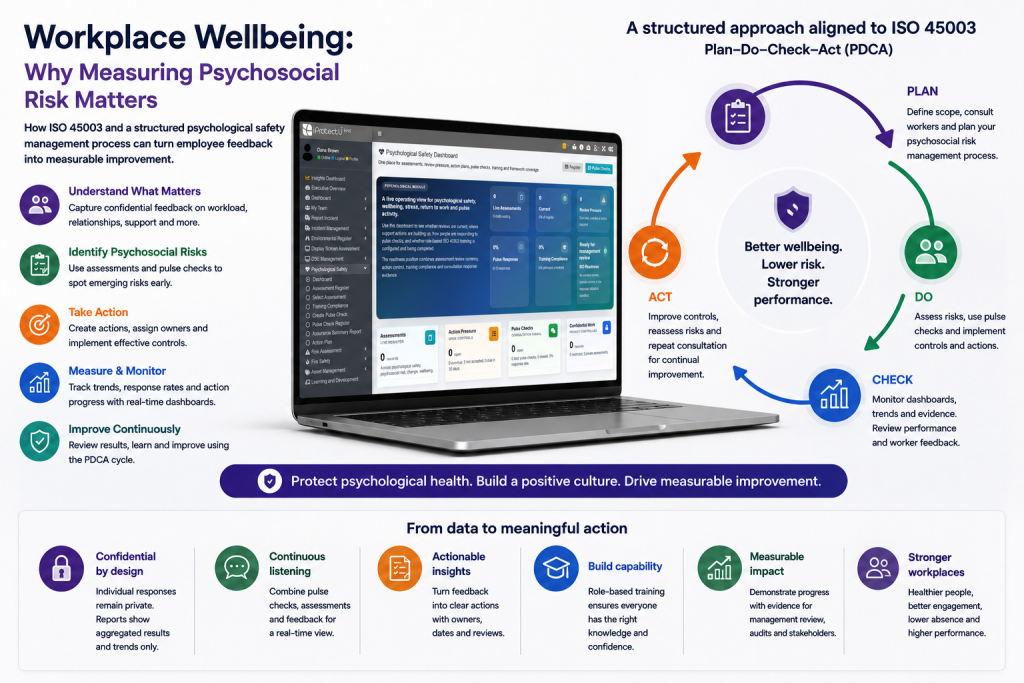
The iProtectU product guidance uses the familiar Plan, Do, Check, Act (PDCA) cycle: plan the scope and ownership of the process; consult workers, assess risk and create actions; review dashboards, trends and evidence; then revise controls, reassess risk and repeat consultation as part of continual improvement.
A richer view of workplace wellbeing can combine multiple indicators, including:
- confidential pulse checks
- psychosocial risk assessments
- sickness absence and employee turnover trends
- training completion
- worker consultation feedback
- action tracking and closure
- management review records

From wellbeing data to psychosocial risk action
Collecting data is only the beginning. The value comes from connecting employee feedback to risk assessment, controls, responsible owners, review dates and evidence of improvement. This creates a repeatable management process rather than a standalone survey exercise.
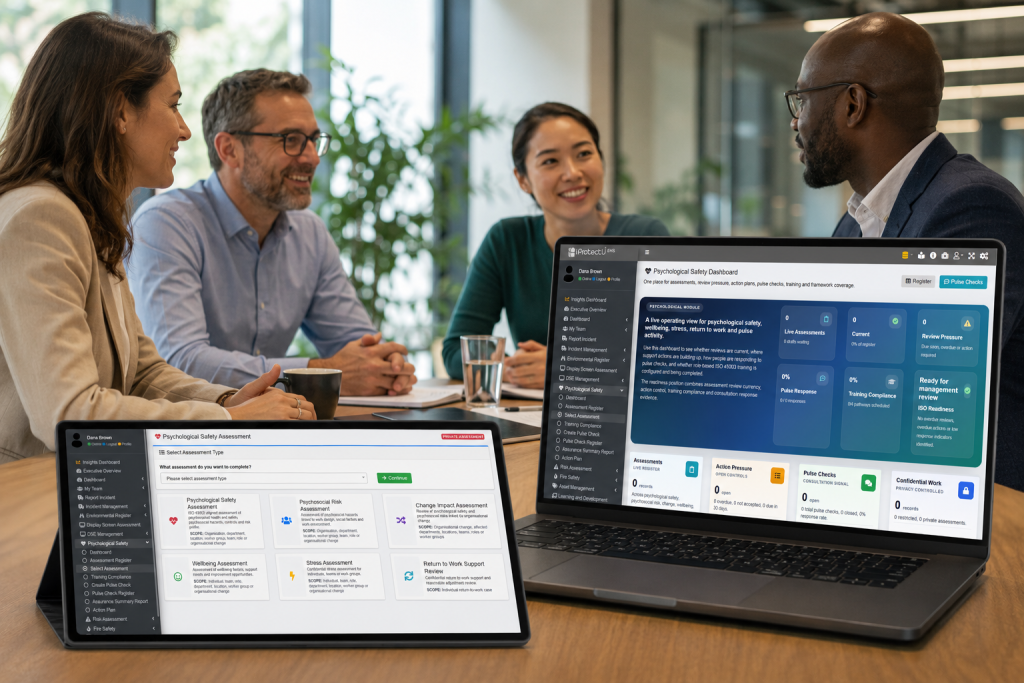
The iProtectU Psychological Safety Management module has been designed to support this workflow. It can help organisations gather confidential pulse check feedback, complete organisational, team or individual psychosocial risk assessments, assign and track actions, monitor trends through dashboards, manage role based training and generate aggregated management reporting.
The attached product guidance also emphasises confidentiality: management reporting should show aggregated status, trends and evidence availability, while sensitive individual assessment narratives remain within permission controlled records.
Protecting confidentiality in psychological safety management
Confidentiality is especially important when employees are being asked to share potentially vulnerable information. People are more likely to engage openly when they understand who can access their information and how it will be used.
During development of the iProtectU module, this became a central design consideration. The guidance distinguishes between organisational, department or team, and individual assessment levels. It recommends aggregated evidence for management review while keeping named responses and individual narratives within appropriate permission controls.
My role in developing the iProtectU approach
In the early stages of the project, I worked within a multidisciplinary team spanning research, legal, logistics, marketing and design. Those discussions helped us move towards a practical wellbeing and psychosocial risk assessment process.
My first aim was to take a step back and think broadly about wellbeing and the workplace. This included:
- What is most important to employers?
- What is most important to employees?
- What are the most common issues with workplace wellbeing?
- How can employees feel heard and represented?
Taking these initial ideas to the team, we discussed how we could implement these concepts into something more specific: wellbeing assessments. Those discussions helped us move towards a practical wellbeing and psychosocial risk assessment process.
Due to my studies at university, something that immediately stood out to me during initial design was confidentiality. As the team developed beta testing models and we started running them to gather feedback, it became clear that the systems would be holding a lot of sensitive data.
For wellbeing assessments to work, employees need to feel comfortable sharing potentially vulnerable information, allowing them to get the support they need.
Having strict controls on who can access data and view survey responses increases employees’ confidence that their wellbeing is taken seriously and that personal information will not be shared to unknown locations. This increases openness in responses, allowing for transparency between employees and employers, making wellbeing improvements more efficient and effective.
As the project continued to develop, I contributed to psychological design elements such as questionnaire wording, content and clarity. To do this, I researched well tested psychological surveys that are already in use. These included:
- Warwick Edinburgh Mental Wellbeing Scale (WEMWBS)
- Patient Health Questionnaire 9 (PHQ 9)
- Generalised Anxiety Disorder 7 (GAD 7)
I analysed each questionnaire and found some design features that stood out to me. For example, the WEMWBS uses positive wording as it focuses on feeling good, not just okay. I felt this was important for measuring workplace wellbeing, as the aim of employers should be to create a thriving workplace, not just a satisfactory one.
Using inspiration from these analyses, I began working with the team to design risk categories for different psychological scenarios that may be identified in the wellbeing assessment.
The use of risk categories in this context is very beneficial to users, as it allows targeted and fast responses to different levels of risk. Furthermore, it allows employees to track risks over time. For example, if after interventions, a risk has dropped from high to low, employers can feel confident their strategies are working to actively improve their employees’ wellbeing, in turn improving overall performance.
Combining the team’s respective ideas, the beta model began developing into the minimum viable product we have today. This project has been very valuable in teaching me the importance of interdisciplinary collaboration, thorough research and consistent quality surveillance. The product we have today is extremely beneficial worldwide; everyone deserves to work in a place that supports them.
The future of workplace wellbeing
Psychological health is becoming an increasingly important part of modern health and safety management. Organisations need more than isolated wellbeing initiatives: they need a process that helps them listen to workers, identify psychosocial hazards, assess risk, implement controls and review whether those controls are working.
When wellbeing measurement is connected to action and continual improvement, it can support healthier workplaces, stronger decision making and a more resilient safety culture.
Ready to strengthen your approach to workplace wellbeing and psychosocial risk management?
Explore iProtectU Psychological Safety Management and request a demonstration at iprotectu.com or email support@iprotectu.co.uk.