
Wellbeing initiatives can start a conversation.
ISO 45003 helps organisations turn that conversation into a managed, measurable and continually improving system.
Fruit bowls, awareness days and employee assistance programmes can all have value. But they do not, on their own, control excessive workloads, poor role clarity, damaging behaviours, weak support or badly managed organisational change. A strong safety culture must protect psychological as well as physical health, and it must be able to show how concerns are identified, acted upon and reviewed. ISO 45003 provides practical guidance for managing psychosocial risks within an occupational health and safety management system based on ISO 45001.
The opportunity is bigger than passing an audit.
Done well, it creates a workplace where people can speak up, leaders can see emerging pressures and agreed improvements do not disappear into spreadsheets or inboxes.
The challenge is turning good intentions into a repeatable management process. That is where connected psychological health, wellbeing and ISO audit software can make cultural change visible, accountable and sustainable.
Wellbeing Is Not a Perk. It Is Part of Risk Management
Move beyond isolated initiatives and address the conditions in which work happens
Many workplace wellbeing programmes focus on helping individuals cope. Support services, resilience resources and awareness campaigns can be useful, but they may leave the underlying causes of harm untouched. If workload remains unreasonable, workers have little control, responsibilities are unclear or change is imposed without meaningful consultation, the risk is embedded in the way work is designed and managed.
A mature organisation therefore asks a different question. Instead of only asking,
‘How can we help this person manage pressure?’, it also asks,
‘What is creating the pressure, who may be affected and what should we change?’
That shift from individual support alone to prevention, participation and organisational actio, is central to stronger psychological health and safety. It also places wellbeing where it belongs: inside leadership, risk assessment, operational control, competence, performance review and continual improvement.
What ISO 45003 Changes
A practical bridge between psychological wellbeing and ISO 45001
ISO 45003:2021 is guidance for managing psychosocial risk within an ISO 45001-based occupational health and safety management system. It is not a separate certification standard. Its value is that it helps organisations apply familiar safety management disciplines to risks that are often less visible than a damaged guard or an unsafe walkway.
- Leadership ownership of psychological health and safety – not delegation to a wellbeing campaign.
- Meaningful worker consultation and participation, with safe ways to raise concerns.
- Identification of psychosocial hazards linked to workload, autonomy, support, relationships, role and change.
- Assessment of who may be affected and where controls or improvements are required.
- Competence, awareness, communication and role-specific training for employees, managers and leaders.
- Monitoring, evidence, management review and continual improvement and not a one-off survey.
For organisations seeking or maintaining ISO 45001 certification, this makes psychological health an integrated part of the management system rather than a separate HR initiative. It supports a more complete view of occupational health and safety performance.
Culture Changes When Speaking Up Leads to Visible Action
Trust is built through the response not through the survey
Employees quickly learn whether consultation is meaningful. Asking people about workload, change, relationships or support creates an expectation that leaders will listen and respond. When feedback disappears into a report, participation falls. When concerns are acknowledged, assessed and converted into visible improvements, confidence grows.
- Make it simple and psychologically safe for people to contribute.
- Use focused pulse checks alongside structured assessments and conversations.
- Look for patterns across teams, sites, roles and periods of organisational change.
- Assign every agreed improvement to an owner with a realistic due date.
- Explain what will change, what cannot change and why.
- Return to employees with evidence of progress and ask whether controls are working.
This creates a powerful cultural loop: listen, understand, act, communicate and review. Over time, people see that raising an issue can improve work rather than create personal risk. That is how psychological safety becomes an operating behaviour, not a slogan.
Use Plan–Do–Check–Act to Make Change Stick
Turn cultural ambition into a repeatable management cycle
The Plan–Do–Check–Act model used by ISO 45001 provides a straightforward route. Plan by defining responsibilities, identifying workforce groups, understanding psychosocial hazards and agreeing objectives. Do by implementing controls, consulting workers, communicating expectations and providing appropriate training and support.
Check by reviewing assessment currency, pulse-check participation, open actions, training completion, recurring themes and evidence that controls have been implemented. Act by investigating gaps, correcting weaknesses and updating the programme as work, people and organisational conditions change.
The important point is continuity. A survey gives you a moment in time; a management system gives you a controlled process. When evidence, actions and reviews are connected, leaders can distinguish activity from progress and auditors can see how the organisation learns and improves.

One Connected System for Psychological Health and Wellbeing
Identify risk, consult employees and coordinate improvement in iProtectU
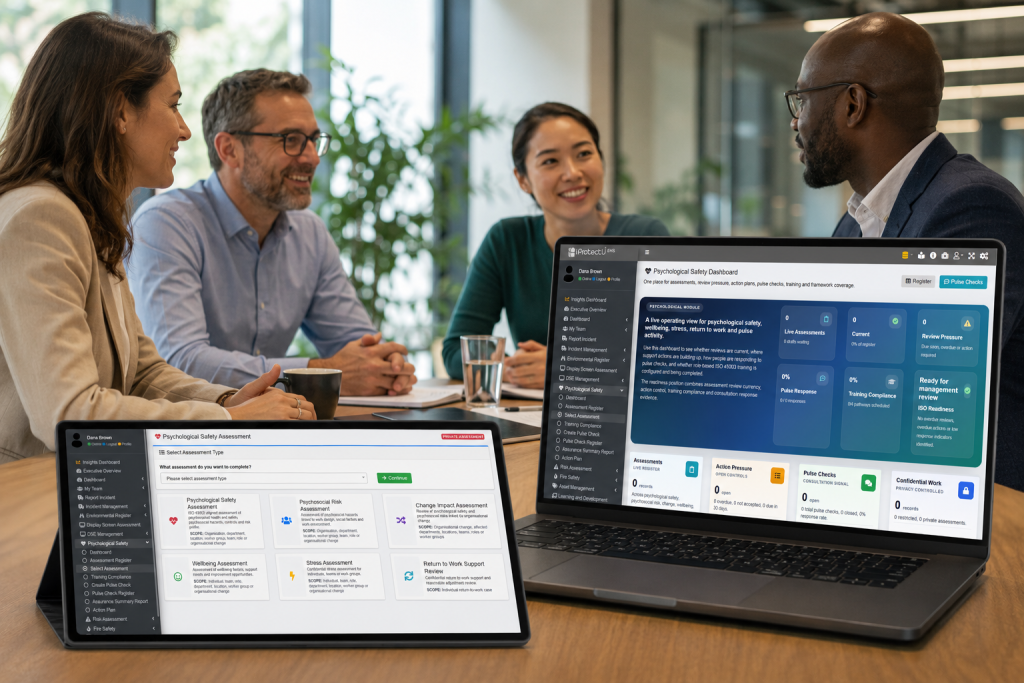
The iProtectU Psychological Health and Wellbeing module brings the practical components of a psychosocial risk programme together. It gives organisations a structured operating view instead of separate surveys, spreadsheets, policies and action lists.
- ISO 45003 audit and gap assessment with findings, evidence and improvement actions.
- Psychological safety, psychosocial risk, wellbeing, stress and change-impact assessments.
- Employee pulse checks and consultation tools to identify concerns and priorities.
- Action plans with owners, priorities, deadlines, reminders and completion evidence.
- Role-based training pathways, confidential access controls, dashboards and reporting.
The result is a clearer line from employee voice to risk decision, from decision to accountable action and from action to reviewed outcome. Leaders can see where review pressure or overdue actions are building, while sensitive records remain controlled through role-based permissions.

Build the Evidence Backbone for ISO 45001
Connect wellbeing activity with audit readiness and wider safety controls
Psychological health should not sit in isolation. iProtectU connects the wellbeing programme to the wider EHS and governance framework. Its ISO Audit Management software supports audit planning, digital checklists, evidence capture, findings, corrective actions, reminders and real-time reporting. This gives organisations a practical way to test whether arrangements are present, current and effective, not simply whether a policy exists.
- Plan and evidence ISO audits, findings and corrective actions
- Connect psychosocial hazards with wider risk assessment and control
- Assign and monitor awareness, manager and leadership training
- Assess psychological impacts when organisational change is proposed
Documents, consultation records, assessments, training, actions and audit results remain connected and traceable. That reduces the scramble before an external audit and, more importantly, gives management a reliable view of whether the system is working between audits.
Is Your Safety Culture Only Half Built?
Make psychological health visible, manageable and capable of improvement
A strong safety culture is not defined only by hard hats, inspections and incident rates. It is also reflected in whether people can raise concerns, whether work is designed responsibly and whether leaders act on evidence. ISO 45003 provides the guidance; ISO 45001 provides the management-system framework. iProtectU helps bring the process, people and evidence together so your organisation can move from good intentions to demonstrable improvement.
Explore iProtectU Psychological Health and Wellbeing Software
Ready to Turn Wellbeing into Lasting Safety Culture?
See how iProtectU can help your organisation identify psychosocial risks, engage employees, coordinate action and strengthen the evidence supporting ISO 45001 and ISO 45003 alignment. Request a demonstration tailored to your organisation.