About our Collaboration
iProtectU has worked in collaboration with a multidisciplinary team to support the development of our new Psychological Health and Wellbeing Software.
Their specialist knowledge has helped us consider the legal, technical, research, design, privacy and compliance requirements needed to create a practical global solution.
In this series, we feature their articles and personal perspectives on the development journey.
About the author
Louis De Maria is a Legal & Product Compliance Analyst at iProtectU, where he participated in the development of the company’s global Wellbeing and Psychological Safety Software platform. His work focuses on ensuring that workplace wellbeing technology is underpinned by robust legal research, international regulatory compliance and ethical design principles.
Louis is currently studying Law at BPP in London and holds a Bachelor of Arts (BA) in History from Cardiff University.
His work includes reviewing employment law, data protection legislation, occupational health and safety frameworks, privacy requirements and emerging global regulatory trends, so the wellbeing software platform can support deployment across multiple jurisdictions.
Working with software developers, compliance specialists and health and safety professionals, Louis helps bridge the gap between law and technology. His work supports a flexible compliance framework based on principles including Privacy by Design, Security by Design and data minimisation, while supporting alignment with international standards including ISO 45003.

From stress risk assessment to a global wellbeing software platform
The workplace has changed dramatically over the last decade. Mental health, psychological safety, employee wellbeing and organisational resilience are no longer simply human resources initiatives; they are increasingly connected to governance, risk management and health and safety.
For organisations, managing stress at work requires more than a single employee survey. A structured approach should help identify psychosocial hazards, assess risk, consult workers, implement appropriate controls and review whether those controls are effective. This is where wellbeing software and a consistent stress risk assessment process can support a wider occupational health and safety management system.
At iProtectU, the Wellbeing Software Project began after a university client requested a stress risk assessment module. The requirement was reviewed at board level, leading to the decision to develop a broader wellbeing software platform designed around ISO 45003 and relevant legal requirements. Specialists from different disciplines then worked together on the legal, operational and product design considerations.
As a participant in the Wellbeing Software Project, my role has been to help ensure that the product is not only innovative but legally robust. Every assessment, workflow and data field needs to be capable of operating across multiple legal systems while respecting privacy, confidentiality and ethical principles.
The legal objective has been to keep the platform scalable and adaptable as it enters new international markets. Research considered legislation, guidance and standards across a range of jurisdictions to identify recognised principles that could inform the product.
Rather than hard coding the legal requirements of one country, the platform allows organisations to configure areas such as retention periods, privacy notices, consent requirements and reporting processes in line with their own legal obligations. This is particularly important for global wellbeing software, where employers may operate across different regulatory environments.
Law as a design principle for wellbeing software
Many software products treat legal compliance as something added towards the end of development. Our approach has been different. Legal research has been embedded from the earliest stages of product design so that compliance can influence architecture rather than become an afterthought.
This “compliance by design” philosophy connects legal governance with software engineering, risk management and user experience. The aim is to support organisations across different countries and legal systems while maintaining consistent standards of employee protection, privacy, confidentiality, security and ethical practice.
Global principles that support health and safety and wellbeing
Instead of attempting to hard code the requirements of dozens of countries, the research identified recurring legal and governance principles, including:
- Privacy by Design
- Data minimisation
- Lawfulness, fairness and transparency
- Confidentiality
- Security by Design
- Accountability and governance
- Ethical handling of wellbeing information
- Accessibility and inclusivity
- Human centred decision making
- Protection of employee rights
These principles provide a foundation that organisations can use when configuring the software to reflect their own national requirements and internal governance arrangements.

Privacy and employee trust in wellbeing software
One of the greatest challenges in designing wellbeing software is balancing meaningful organisational insight with employee privacy. Wellbeing information can be highly sensitive, and employees are more likely to engage honestly when they understand how their information will be handled.
The research therefore placed significant emphasis on recognised privacy principles, including lawful and transparent processing, purpose limitation, data minimisation, accuracy, appropriate retention, confidentiality and appropriate technical and organisational security measures.
The practical recommendation is straightforward. Collect only the information genuinely required, explain why it is collected, protect it appropriately and retain it only for as long as necessary.

ISO 45003, psychological health and safety and psychosocial risk assessment
ISO 45003:2021, Occupational health and safety management, Psychological health and safety at work, provides guidance on managing psychosocial risks within an occupational health and safety management system. The iProtectU wellbeing platform has been designed to create an evidence based management process aligned with ISO 45003.
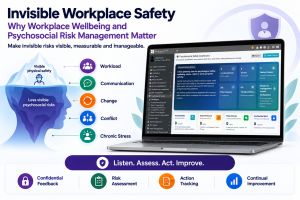
The platform brings together worker consultation, psychosocial risk assessment, training, action management and continual improvement within a repeatable governance cycle. Dashboards and reports can provide aggregated evidence while avoiding unnecessary exposure of confidential individual narratives.
The operating model follows the Plan, Do, Check, Act cycle, helping organisations to:
- Plan how psychosocial risks and stress at work will be managed.
- Consult workers and gather relevant wellbeing information.
- Assess psychosocial hazards and complete structured stress risk assessments.
- Implement and assign controls and actions.
- Check evidence, trends and the effectiveness of controls.
- Act on findings and continually improve the psychological health and safety approach.

What organisations should look for in wellbeing software
For employers evaluating wellbeing software or stress risk assessment software, functionality should support a systematic health and safety process rather than simply collect survey scores. Useful capabilities include consultation, configurable assessments, psychosocial risk management, action tracking, training, aggregated reporting, privacy controls and evidence for continual improvement.
Technology does not replace an organisation’s legal duties or professional judgement. Instead, well designed software can help create a consistent process, improve visibility of actions and provide evidence that psychological health and safety is being managed as part of wider organisational governance. iProtectU’s ISO Standards and Audit Management Software can also support the wider assurance, audit and evidence management process.
More than compliance
The goal of the iProtectU Wellbeing Software platform is to help organisations build healthier workplaces, strengthen psychological safety and create trust through responsible technology. Privacy, governance and employee rights have been considered from the beginning of the product lifecycle.
When law, technology, wellbeing and health and safety are designed together, compliance can become more than a regulatory obligation. It can provide the foundation for a structured approach to stress at work, psychosocial risk assessment and better workplaces around the world.