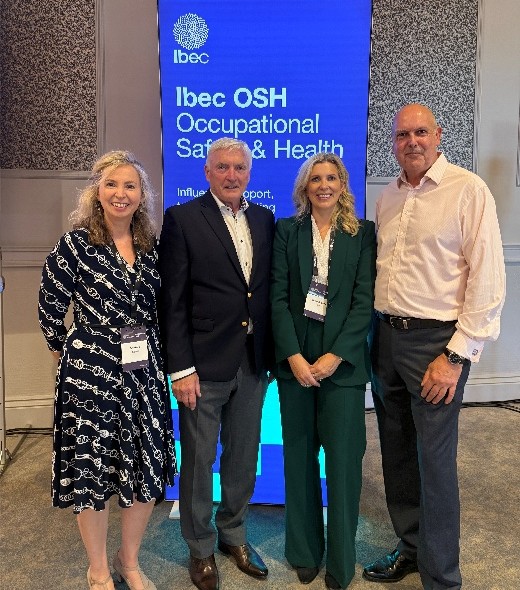

An opportunity to meet with our clients, such as University College Dublin.
Left to Right:
Sarah Carry UCD SIRC Manager
Sally Beck iProtectU Compliance Director
Tania Bautista UCD Project Coordinator/Technical Project Management Specialist
UCD Safety, Insurance, Operational Risk and Compliance (SIRC) Offic
Empowering OSH Professionals to Lead with Impact
iProtectU was proud to sponsor the Ibec OSH Seminar 2026 – #InfluenceOSH, centred on a clear and timely theme: empowering OSH professionals to lead with impact through communication, culture and confident leadership.
The theme reflected a challenge familiar to safety professionals everywhere. Good systems, policies and procedures are essential, but their effectiveness depends on how well people communicate, how strongly safety is embedded in culture and how confidently leaders influence behaviour and decision-making.
For iProtectU, that message strongly aligns with the way we see modern occupational safety and health management.
Technology can provide structure, visibility, evidence and assurance. But meaningful safety improvement still depends on people, how they communicate, how they lead and how effectively they turn intent into action.
Communication: making sure the message lands
Tom Beegan on safety communication
A particularly relevant contribution came from Tom Beegan (iProtectU and Beegan Associates), former CEO of the Health and Safety Authority and former Honorary Vice President of IOSH, who delivered a thought-provoking presentation on Safety Communication.
Tom opened with a George Bernard Shaw quotation:
“The single biggest problem in communication is the illusion that it has taken place.”
The point is simple but important: communication is not complete simply because something has been said, written or issued.
A policy may exist. A toolbox talk may have been delivered. A risk assessment may have been completed. But the real test is whether the message has been understood and translated into the way work is actually carried out. For OSH professionals, this means moving beyond the evidence that a communication happened and asking whether it influenced behaviour, decisions and day-to-day practice.
Culture: closing the gap between intent and impact
Where work as imagined meets work as it is done
Tom also explored the gap between work as imagined and work as experienced by workers. This is where safety culture becomes visible. Strong systems can still be weakened if the practical reality of work drifts away from the intended process.
- Are procedures clear, practical and understood by the people expected to follow them?
- Do supervisors receive consistent messages about safety, quality and productivity?
- Can workers raise concerns, challenge unsafe practice and speak up without unnecessary barriers?
- Are hazards, near misses and early warning signals acted upon before they become incidents?
- Do corrective actions resolve the underlying issue rather than simply close the record?
- Are organisations learning from what actually happens at the point of work?
One of Tom’s strongest lines captured this perfectly:
“Conversations take place in the actual place of work – where work as imagined meets work as it is done.”
Safety culture is not something that exists only in policies or dashboards. It is demonstrated in those everyday conversations, decisions and interventions.
Confident leadership: strengthening the Supply Chain of Influence
Every person is a link in the chain
A central idea in Tom Beegan’s presentation was the “Supply Chain of Influence”. Policies, procedures, codes of practice, audits, induction, training, toolbox talks, safety professionals, supervisors and workers all influence what ultimately happens in the workplace. The challenge is to identify where that chain may weaken before a weak link contributes to harm.
- Create clarity around roles, responsibilities, relationships and expected results.
- Coach supervisors and line managers to manage safety confidently as part of everyday work.
- Integrate safety, quality and productivity rather than allowing them to become competing messages.
- Use leading indicators and early warning signals, not only lagging injury statistics.
- Encourage respectful challenge and give people the confidence to intervene and speak up.
- Keep looking for weak links instead of declaring success too soon.
Tom described this as continuous “weak link hunting”. That is a useful way to think about modern safety leadership: not waiting for failure, but continually looking for the small signals, inconsistencies and behaviours that show where the system needs attention.
Doing the basics brilliantly
Leadership creates impact when the fundamentals are strong
Another message that resonated strongly was Tom’s call to focus on “doing the basics brilliantly”. Health and safety management does not always need another layer of complexity. Often the biggest improvement comes from getting the fundamentals right: clear responsibilities, relevant communication, effective supervision, meaningful worker engagement, timely corrective actions and honest learning from incidents and near misses.
The Ibec theme of communication, culture and confident leadership comes together here. Safety professionals create the greatest impact when they influence what happens in everyday work. That means helping people understand not only what they are expected to do, but why it matters, and giving supervisors and managers the confidence and information to act when something does not look right.
It also means recognising that safety, quality and productivity should reinforce one another. Problems emerge when organisations say safety is the priority while operational pressure encourages shortcuts. Confident leadership removes that contradiction and makes safe, right-first-time work part of the same objective.

An opportunity to meet with clients, Baclay Chemicals.
Left to Right:
Frank Kwabena Amarchie – Barclay Chemicals
Tom Beegan – iProtectU and Beegan Associates
Sally Beck – iProtectU Compliance Director
Damir Vojnic – Barclay Chemicals
Where technology supports better leadership
Technology should strengthen influence, not replace it
At iProtectU, our role is to help organisations create the visibility and structure that support better decisions. A modern EHS and QHSE platform should do more than digitise forms. It should connect information across the safety management system so that leaders can see where intervention is required and where patterns are beginning to emerge.
- Connect incidents, hazards, risk assessments, audits and corrective actions.
- Give managers visibility of overdue actions, recurring issues and emerging trends.
- Link training and competence records to the risks and activities they support.
- Provide evidence that controls, reviews and actions are being completed and followed through.
- Help OSH professionals spend less time chasing information and more time influencing improvement.
Technology can make information visible, automate processes and provide stronger evidence. But it remains the enabler. People create the culture and leadership creates the impact. The strongest results come when good systems support better conversations and more confident decisions.

Continuing the #InfluenceOSH conversation
Thank you to Ibec, our clients and everyone who joined us
We were delighted to sponsor the Ibec OSH Seminar 2026 and to spend the day with customers, safety professionals and industry colleagues. The theme of empowering OSH professionals to lead with impact through communication, culture and confident leadership is one that deserves to continue well beyond the event.
A sincere thank you to Ibec, all of the speakers and attendees, and to Tom Beegan for a thought-provoking presentation on communication, behaviour and the Supply Chain of Influence.
For us, one message stood out clearly:
Strong safety performance is built when good systems, good communication and confident leadership reinforce one another.
- Explore iProtectU EHS software modules
- Incident reporting and management software
- Risk assessment software
- eLearning and training management software
The conversations at #InfluenceOSH reinforced why the human side of safety management matters so much. Systems should help OSH professionals lead, communicate and influence – not simply create more administration.
Turn safety information into meaningful action
Connect the information your leaders need
See how iProtectU can help your organisation connect health, safety, risk and compliance information across one configurable EHS and QHSE platform, giving teams clearer visibility of risks, actions, training and performance.
Ready to strengthen safety visibility and leadership?
Request a demonstration of iProtectU and see how connected EHS and QHSE software can support your organisation’s safety communication, risk management, learning and continuous improvement.