
About our Collaboration
iProtectU has worked in collaboration with a multidisciplinary team to support the development of our new Psychological Health and Wellbeing Software.
Their specialist knowledge has helped us consider the legal, technical, research, design, privacy and compliance requirements needed to create a practical global solution.
In this series, we feature their articles and personal perspectives on the development journey.
About the author
Sophia Merino is a Legal Compliance Research Associate collaborating as part of a multidisciplinary team with software developers, UX designers, product managers, researchers and compliance specialists; she contributes throughout the entire product lifecycle, from initial concept and user research through design, development, minimum viable product (MVP) and market launch.
Sophia focused on ensuring that legal compliance, privacy and recognised good practice are embedded into the wellbeing product. This includes researching international legislation, reviewing regulatory frameworks, supporting GDPR and privacy by design principles, and helping align the wellbeing product with the recognised standard ISO 45003.
This article reflects her experience of contributing to the development of a new workplace wellbeing platform, illustrating how successful SaaS products are created through close collaboration between legal, technical, design and research teams, with compliance and good practice considered at every stage of the product journey.

Beyond compliance
My name is Sophia Berg Merino, and I had the opportunity to contribute to the development of a new iProtectU module focused on workplace wellbeing. The project aims to support both mental and physical wellbeing, helping organisations move beyond simply meeting legal obligations to creating healthier, safer and more supportive workplaces.
The idea for the module originated when clients using the iProtectU software requested a dedicated wellbeing or psychosocial module within the iProtectU health and safety platform. With workplace wellbeing continuing to gain prominence across industries and regulatory frameworks, it quickly became clear that this was not simply a feature request; it represented an opportunity to develop a product that could genuinely improve organisational culture while supporting legal compliance.
The initial thinking process
Before designing the solution, our first challenge was understanding the problem we were trying to solve. Employers increasingly need practical ways to identify and monitor psychosocial risks, workplace stress and factors that can negatively impact employee wellbeing. At the same time, organisations must demonstrate that they are meeting their health, safety and wellbeing responsibilities under an evolving range of national and international legal requirements.
I joined a multidisciplinary team of researchers, software developers, UX designers, compliance specialists and legal experts. Alongside technical development, the project required close collaboration across branding, marketing, information security, privacy and legal compliance. Through a series of meetings, we shared ideas and feedback, with each member of the team contributing from their particular field of knowledge.
As part of my academic studies in Law at the University of Bristol, workplace wellbeing and regulatory compliance were already areas of particular interest. During the project, I worked closely with the team reviewing content, privacy considerations and GDPR requirements, ensuring these principles were embedded throughout the platform. Participating in product initiation workshops and research activities provided valuable insight into how successful SaaS products are shaped through collaboration across multiple disciplines.
Ensuring global adaptability
One of the earliest and most significant design decisions was recognising that this would be a truly global product. To ensure multinational adaptability, two key aspects were established: the module’s features had to be adaptable, and the guiding legal foundation of the module had to be internationally recognised.
Rather than attempting to create a single solution that satisfied every legal jurisdiction, the team focused on building a flexible compliance framework capable of adapting to different legal systems and regulatory requirements. Fortunately, the existing iProtectU platform already provided configurable compliance capabilities across its other modules, which gave us a strong architectural foundation. This allowed the team to concentrate on designing wellbeing functionality that could be tailored to local legal requirements while maintaining consistent standards of governance, security, privacy and user experience.
In keeping with the goal of developing a global product, the module’s development was guided by ISO 45003, the international standard for managing psychosocial risks and promoting psychological health and safety at work. Using ISO 45003 as the core framework enabled us to design a solution based on internationally recognised best practice while allowing organisations to configure the platform to reflect their own national legislation, workplace policies and organisational needs.
This approach ensures that the software remains both practical and scalable. Rather than locking organisations into a rigid compliance model, the platform provides the flexibility to evolve alongside changing legislation, emerging best practices and expansion into new international markets.

Naming the product
Another part of this journey that I contributed to was the naming of the product and the features within it. We wanted a name that represented how psychosocial compliance should be viewed by organisations, not simply as a legal compliance requirement, but as a commitment to protect and support their employees. That is why clear, simple, yet effective names such as ‘workplace wellbeing’ and ‘wellchecks’ were decided on; names that humanise the module, making it approachable both for those conducting wellness reports and for employees completing wellness surveys.
Testing the product
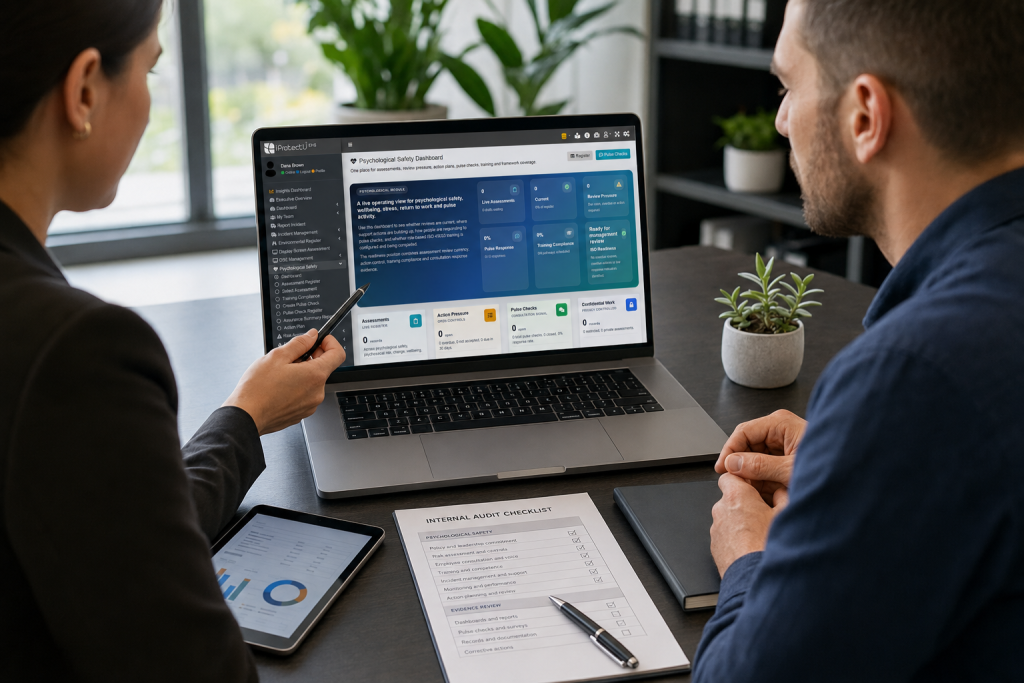
During the final testing stages of the beta version of the product, I accessed the trial software from a range of different testing accounts, each with different permission settings. Throughout my testing, I kept in mind privacy considerations, such as which parts of the module would be visible to whom, and fed back to the developers. This allowed me to highlight any final compliance issues or user experience issues, ensuring the product was faultless and ran clearly and smoothly.

Ultimately, this project reinforced an important lesson
Workplace wellbeing requires more than straightforward legal compliance. Designing a global wellbeing platform requires balancing innovation with legal responsibility, flexibility with consistency, and user experience with robust governance. It is this balance that will enable organisations to confidently meet today’s requirements while remaining prepared for tomorrow’s evolving workplace landscape.
This module will allow employers across the world to not only improve their current legal compliance but also better identify wellbeing risks, communicate with employees and ensure a safe, positive working environment.
From concept to development
Overall, being part of the journey from concept to development has shown me that the most successful products are those built with a clear purpose, collaboration and a genuine understanding of the people they are designed to serve.